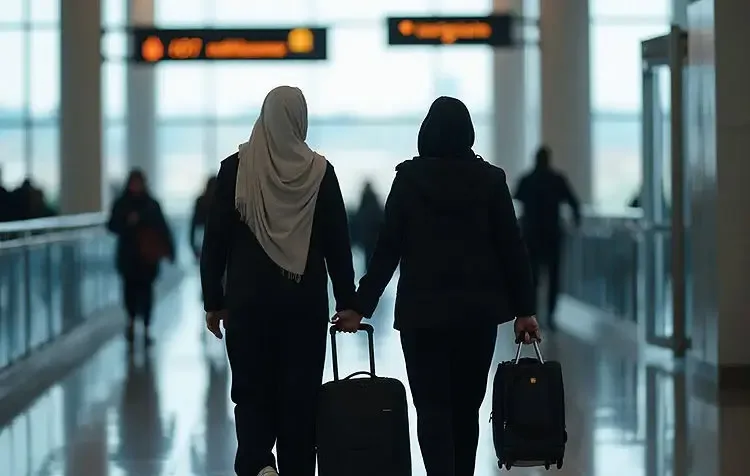
The desire for immigration among Iranians has sharply increased in recent years. These changes are particularly influenced by wars and economic crises. Specifically, war and economic issues, alongside parliamentary plans and foreign sanctions, are considered the main reasons for the desire to immigrate. However, economic conditions can act as a significant barrier to immigration as much as they foster the desire to leave.
Concerns About Immigration and Widespread Advertising
Immigration advertisements are currently abundant in all virtual and physical spaces. If two years ago, educational immigration and the immigration of doctors and nurses were at the forefront, now the war and the difficult economic situation in Iran have turned the topic of immigration into a serious issue. According to research, only 16% of respondents have not thought about immigration, indicating serious concerns in this area.
Seyed Reza Salehi-Amiri, the Minister of Culture and Islamic Guidance in Hassan Rouhani's government, announced in 2024 that the public's desire to immigrate has reached 60%, and this figure has increased to 67% among students. Additionally, according to provided statistics, the population of Iranian immigrants reached 1,870,000 in 2020, indicating that the number of immigrants has doubled compared to 30 years ago.
Influential Factors on Immigration Patterns
According to a report published by the Jamaran news and information website in 2026, about 45% of individuals under 29 and 55% of those with university education have a desire to immigrate. The further one moves from Tehran to rural areas, the less the desire to immigrate becomes. Various factors, including war and economic issues, along with plans like the "Infiltration Plan," which focuses on research and scientific connections with foreign countries, are presented as significant reasons for the decision-making of youth and elites regarding immigration.
Globally, uncertainty about the future is recognized as an important factor for immigration in various countries. Surveys in Europe have shown that nearly half of the residents of France, Germany, Italy, and the UK wish to live in another country. The cost of living crisis is cited as the main reason for the inclination to immigrate in these countries.
However, experience shows that the immigration pattern of Iranians due to war differs significantly from other countries. Contrary to expectations, widespread immigration by Iranians to the borders of the country, especially the Turkish border, has not occurred in practice.
Mahmoud Moshfeq, an associate professor in the Department of Demography at Allameh Tabatabai University, emphasizes that immigration is a multifactorial phenomenon and is not solely dependent on the harshness of internal conditions. According to him, immigration can be broadly divided into voluntary and forced categories. While forced migrations arise from environmental pressures and war, economic conditions and sanctions also contribute to the increased desire to immigrate.
Ultimately, Moshfeq states that the desire to immigrate may stem from poor economic conditions, but as long as individuals are unable to cover the costs of immigration, this desire will not materialize into action. In fact, immigration restrictions both inside and outside the country prevent the desire to act on immigration from being directly realized.
Overall, economic and social conditions, wars, and sanctions are all factors that influence the desire for immigration among Iranians, but the lack of necessary infrastructure for immigration remains the main barrier on this path.
Read more: Increase in oil exports from Arab Gulf countries and decrease in Iran's influence in the Strait of Hormuz · A new test for industries with the liberalization of household appliance imports