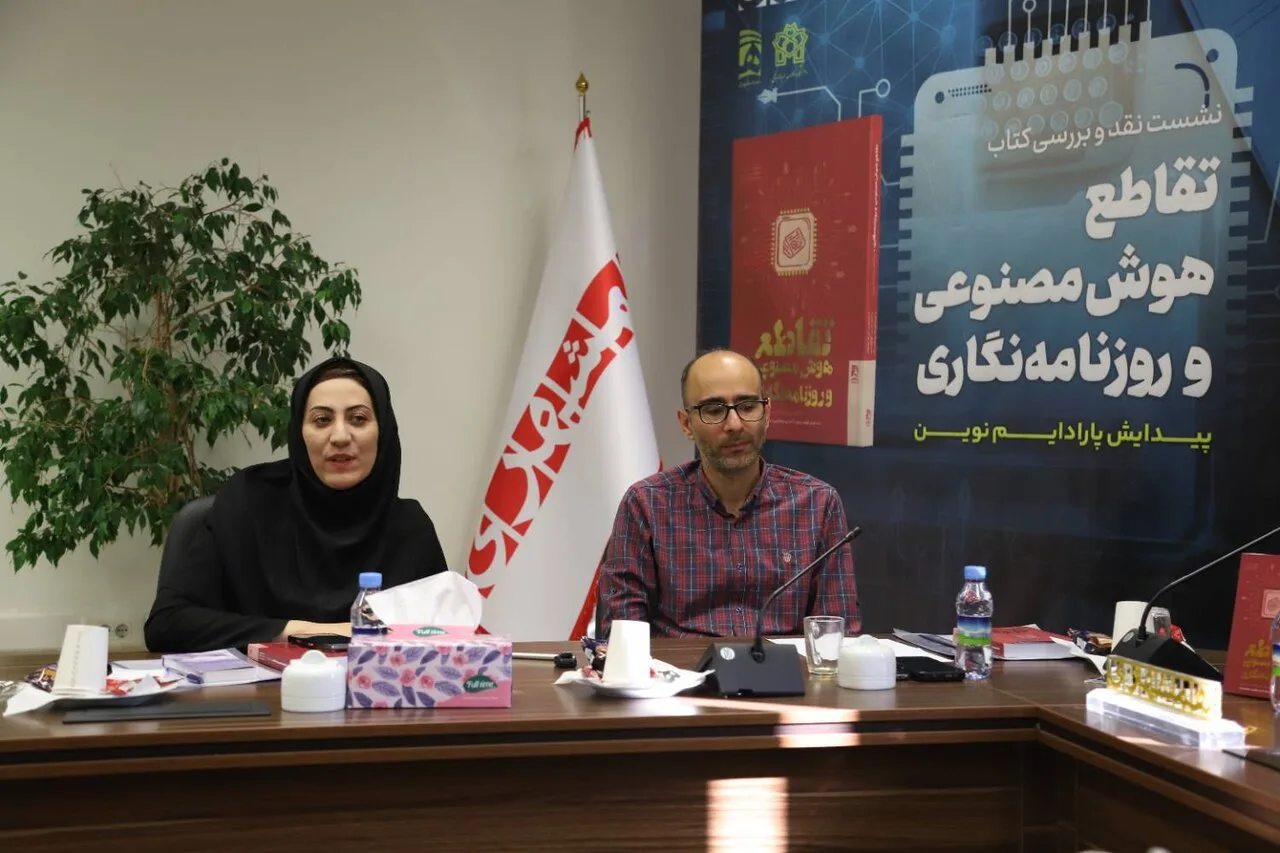
Aliollah Salimi; the book launch and introduction session of "The Intersection of Artificial Intelligence and Journalism; The Emergence of a New Paradigm," written by Santosh Kumar Biswal and Anand G. Kulkarni, translated by Ali Shaker, was held with the presence of Dr. Mohammad Mahdi Molaei, a faculty member of the Faculty of Communications at Allameh Tabatabai University, and Dr. Setareh Bonyadi, a researcher in science communication, along with Dr. Ali Shaker, the translator of the book, and a group of journalists, students, and researchers in the field of communications, as well as enthusiasts of artificial intelligence and media, at the Hamshahri newspaper office.
The Role of Journalists in the Age of Artificial Intelligence
During this session, it was announced that the journalist of the future must be both a collaborator and a critic of artificial intelligence. Ali Shaker, the translator of the book, pointed out at the beginning of the session that in the age of artificial intelligence, the role of humans is not only not diminished but becomes more vital than ever. He emphasized that the journalist of the future is no longer just a writer or reporter but must acquire new skills such as data literacy and understanding algorithms.
Read more: Mehdi Mahouzi, Iranian writer and researcher, has passed away
Shaker said: "Journalism education must transform so that newcomers can work with these tools while maintaining their critical perspective." He added that in a world where machines can produce information, the unique role of humans in storytelling and the search for truths will be more pronounced than ever.
New Challenges and Opportunities
Dr. Setareh Bonyadi, a researcher in science communication, mentioned the importance of understanding the specific type of artificial intelligence. She said: "When we talk about artificial intelligence, we must first ask which artificial intelligence we are referring to." Bonyadi explained that artificial intelligence, especially in its new generations, can play a role in critical decision-making such as surgery, and this creates new challenges for journalists.
She added: "The questions raised about the position of humans in relation to artificial intelligence should focus on what ecosystem and what oversight we are discussing artificial intelligence in." This researcher emphasized that more attention should be paid to human responsibilities in interacting with artificial intelligence.
Dr. Mohammad Mahdi Molaei, a faculty member at Allameh Tabatabai University, also pointed out that the topic of artificial intelligence should be viewed as more than just a simple tool. He said: "Artificial intelligence is changing all relationships, and this paradigm shift is transforming all professional and occupational fields." Molaei added that journalism is not exempt from these changes and should be seen as a sustainable transformation.
Read more: How to make shrimp omelet; a quick dish with a delightful taste · The AI tool "FaceSurvival" predicts the fate of cancer patients