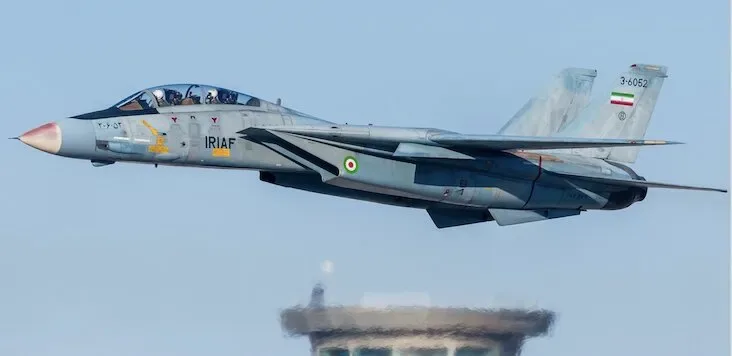
The Iranian Air Force has enhanced its military and defensive capabilities by deploying its F-14 and F-5 fighter jets at the borders. These activities occur as Iran faces a higher likelihood of confrontation with the United States and Israel following a previous military operation against its targets on February 28, 2026. On October 19, U.S. Secretary of Defense Lloyd Austin met with Israeli Prime Minister Benjamin Netanyahu, and their discussions focused on ongoing military efforts against Iran.
Iran's Military Actions Against Threats
The deployment of Iranian fighter jets for border patrols comes at a time when it was reported on October 19 that approximately 10 Israeli Air Force fifth-generation F-35 jets have repeatedly flown from the airspace of Syria and Iraq and conducted simulated attacks. While the F-35 is the only operational fifth-generation fighter in the Middle East, it is still not suitable for intense combat due to delays in reaching Block 4 standards and lacks air-to-ground missile capabilities.
Read more: Mohsen Rezaei and Asim Munir; A Different Greeting Amid Arab Media
Despite these limitations, Iran's fleet of fighter jets is considered outdated, especially the F-14 and F-5 jets purchased in the 1970s, compared to newer aircraft. The MiG-29s acquired by Iran in the late 1980s have also not been upgraded to modern "Generation 4+" standards.
Large-Scale Exercises and Iran's Capabilities
In mid-October, the Iranian Air Force deployed its F-14 and F-5 jets to participate in large-scale exercises. These exercises included the launch of several ballistic missiles and the deployment of single-purpose attack drones. While the F-4 and F-5 still form the backbone of Iran's fleet, the limited number of F-14s is valued for their ability to intercept cruise missiles at long ranges. This type of fighter jet was the first in the world with such capability.
American Tomahawk cruise missiles, designed to intercept supersonic cruise missiles, target objectives at subsonic speeds. Although the F-14, F-4, and F-5 jets are considered outdated for air-to-air engagements, they have multiple applications; F-4s and F-5s have penetrated heavily defended airspace during offensive missions, surprising analysts.
Iran is expected to revolutionize its fighter jet fleet capabilities next year with the delivery of the first long-range Russian Sukhoi-35 and Sukhoi-30 Generation 4+ aircraft. The Komsomolsk-on-Amur Aircraft Plant, which produces the Sukhoi-35, announced in early July that the production of 20 of these jets for the Iranian Air Force has been completed, and another 28 jets are expected to be produced to meet existing orders.
Additionally, there are several indications that Iran is one of three foreign countries that have ordered the Russian fifth-generation Sukhoi-57 fighter jet. However, the exact delivery time for these modern aircraft is still unclear, and until then, Iran's defense will continue to rely on ballistic missiles, drones, and advanced fortifications.
Read more: Gholamhossein Darzi Sent a Letter to the Security Council Regarding the Maritime Blockade · Several Men Arrested Near British Air Force Base on Suspicion of Explosive-Related Crimes