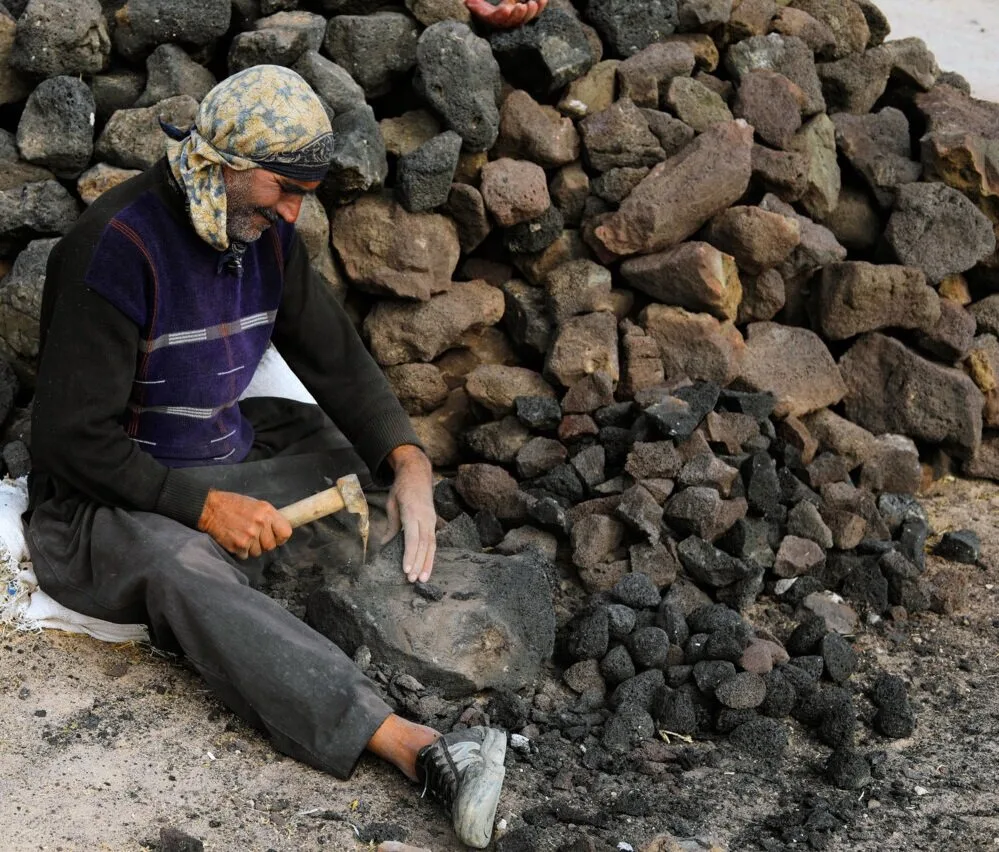
The village of Qazlajekand in the Qorveh County of Kurdistan Province, with a population of over eight hundred, is a place where the residents' livelihood comes from the volcanic lava of the Zagros Mountains. This lava, which has erupted from Sabalan and Sahand, has settled on the slopes of Mount Siyah and turned into mineral pumice. The people of Qazlajekand have been making pumice stone from these pumices for years, and customers from the nearest cities to the farthest corners of the world benefit from the products of this village.
Carving Pumice Stone: A Traditional Art in the Hands of Young and Old
The sound of chisels from the people of Qazlajekand can be heard in this village after sunrise. Young and old, after having breakfast, go to their workshops and start carving pumice stones. Azizollah Seyfi, one of the veterans in this field, takes pride in his sharpness and precision with 70 years of experience. He jokingly says, "I'm the original pumice stone maker who won't stop working even at 80 with this hand tremor."
Read more: Support of Gilan University Students for Hijab-Wearing Women of Azerbaijan in Astara
The village children also join the family business with small chisels. Savash, Azizollah's grandson, curiously says, "Grandpa, look how well I hit the hammer..." Azizollah reminds that this profession goes back to his ancestors and emphasizes that they have agricultural land, but the quality of the pumice has made stone polishing their main occupation.
Mines and Livelihood of the Village
Mohammad Saidi, another young resident of Qazlajekand, has taken up work in the village mine and says, "These mines are formed from the sediment of volcanic materials." He, who is responsible for extracting pumice, believes that these mines provide the village's livelihood. Large mineral pumices are sold to construction material factories, and the "waste pumices," which are the smaller pumices, reach the stone polishers of Qazlajekand.
Saeed Asadpour, the village chief of Qazlajekand, talks about the buying and selling of mineral pumices. He adds that the quality of the mineral pumices from Qazlajekand is unparalleled, and for years pumice stones were sold to various countries, including Turkey and France. However, now out of 200 stone polishing workshops, only 40 are active.
Maryam Ghareh-Daghi, one of the stone polishers, talks about the wounds caused by working with rough pumices and mentions the dental problems that have strangely become common among the villagers. In search of the cause of this issue, she refers to studies on social media.
As the sun sets, the sound of chisels fades away, and the prepared pumice stones are piled into plastic bags to go to the market the next morning.
Read more: The Leader of the Revolution Appears Incognito in the Fields · Mohsen Mohammadi, the Kolber Blogger: Income and Challenges of Kolbari in Kurdistan