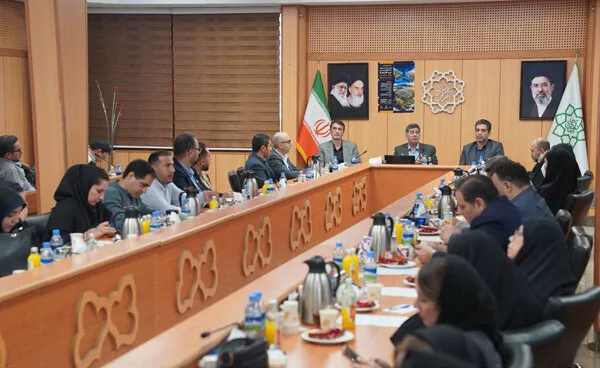
The management of Tehran's boundary, as one of the main challenges in urban policymaking, requires serious attention and coordination among decision-making institutions. In a meeting dedicated to examining the development process of the capital and changes in urban policymaking, the director general of the boundary of Tehran Municipality, Mehdi Mazinani, elaborated on the existing challenges and opportunities in this area.
The Historical Development Process of Tehran
Mazinani, in this meeting, referred to the history of Tehran's population, saying: "Tehran had only 10,000 inhabitants during the Qajar period, but this figure reached 600,000 in 1941 and 1.5 million in 1956. This population increase brought challenges such as traffic, lack of infrastructure, and informal settlements, which confronted urban management with numerous problems."
Read more: Gharibabadi: Using the 'Lamerd' Stadium for Testing Weapons is a War Crime
The director general of the boundary of Tehran Municipality added: "In response to these developments, two fundamental approaches, including the preparation of a comprehensive plan for Tehran and decentralization from the capital, were put on the agenda. Until the victory of the Islamic Revolution, the comprehensive plan was the main basis for the city's development." This rapid growth has turned challenges such as traffic and informal settlements into driving forces for urban management.
The Necessity of Coordination Among Institutions in Boundary Management
Mazinani explained the objectives of the new plans: "The integration of management over the use of boundary lands and the development of green and public open spaces are among the goals of this plan. These spaces should have recreational, leisure, and tourism functions, and also provide temporary housing for the population in emergency situations."
He pointed out the governance challenges in the capital's boundary, saying: "One of the fundamental issues in this area is legal challenges. While many advanced cities have comprehensive and unified laws for boundary management, in Tehran, the multitude of decision-making institutions, from the municipality and governorate to the Ministry of Roads and Urban Development and the Agricultural Jihad, has made coordination in managing this area difficult."
Global Models and International Experiences
The director general of the boundary of Tehran Municipality, referring to the methodology for identifying global patterns, said: "To achieve the most optimal protective model, we first identified 15 metropolises with boundaries worldwide and used the Analytic Hierarchy Process (AHP) to select 5 of the most similar models for the capital's boundary, which included the metropolises of Ankara, Baku, Delhi, and management models from China and South Korea."
Mazinani added: "Our findings show that almost all metropolises in the world, even in the most advanced countries, face serious challenges in boundary protection."
Mehran Ehsani, a researcher in urban studies and architecture, pointed to the pressures that several dozen cities surrounding Tehran exert on this metropolis, stating: "The logic of successful metropolises is not to prevent the city's expansion but to guide this expansion. In this regard, we must also take such action, as success in boundary management can only be achieved when public transportation is accessible to everyone."
Mostafa Talashi, head of the Urban and Rural Development Research Institute, also emphasized that the management of metropolises' boundaries is not just about managing a specific area, stating: "We need to organize structures, relationships, flows, and institutions within the operational realm of the city and its surroundings with a clear mechanism for decision-making, implementation, monitoring, and accountability."
He added: "Tehran Municipality, as a technical and executive driver, can serve integrated governance and act as a guiding and policymaking reference in this area."
Read more: The Launch of the 'Readiness' Campaign by Mohsen Keshavarzi in Tehran · Abbas Ashouri: Public Participation in Monitoring Migratory Birds in Gilan is Highly Important