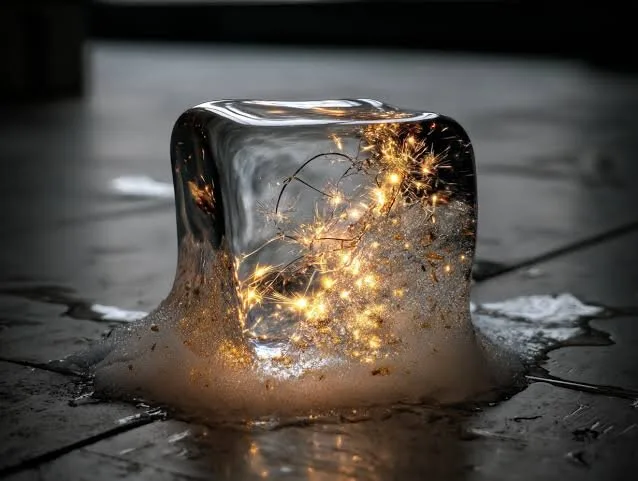
Researchers have managed to bring water inside very thin silica tubes to a state that resembles a solid in terms of shape and mechanical behavior, while lacking the crystalline structure of regular ice. This new state remains stable even at various temperatures ranging from minus 20 to plus 90 degrees Celsius.
Water in Silica Tubes
Water typically flows easily when poured into a container and takes its shape when the container is tilted. However, in this experiment, water inside silica tubes encountered specific characteristics. When the water was released from these tubes and examined with precise instruments, it maintained its shape and did not flow easily.
Read more: Tehran Among the Top 100 Innovation Clusters in the World; Ranked 65th in WIPO Assessment
Advanced methods such as Raman spectroscopy, infrared spectroscopy, and nuclear magnetic resonance have shown that the water molecules in this state have very limited movement compared to regular water. Additionally, structural analysis using electron diffraction indicates that there are no signs of the regular crystalline structure of ice. For this reason, researchers describe this state more as amorphous and solid-like water, rather than the usual crystalline ice.
The Effect of Size on Water Behavior
Researchers found that the inner surface of these very small tubes has specific chemical groups known as silanol (SiOH) that can form hydrogen bonds with water molecules. When the diameter of the tube becomes sufficiently small, the number of these surface interactions becomes very significant compared to the volume of water. This means that the movement of water molecules is restricted, and a network of bonds forms that helps create the solid-like state. In other words, water in a very small space is no longer the same water we see in a glass.
In the conducted experiments, researchers examined tubes of various diameters and obtained interesting results. When the inner diameter of the tube reaches about 2 to 5 micrometers and becomes smaller, the behavior of water changes from a liquid state to a solid-like state. In larger tubes, water behaves more normally. This finding indicates that the size of the space at the microscopic scale can alter the material characteristics of familiar water.
One of the most fascinating aspects of this research is that the solid-like water in the experiments maintained its shape at different temperatures, from minus 20 to plus 90 degrees Celsius. Additionally, a sample that was about 100 nanometers thick retained its solid-like shape even after 54 days. These new characteristics of water could have significant implications for our understanding of this vital liquid and its applications in modern technologies.
Read more: Customers in the Mobile Repair Market Face Price and Quality Challenges · Heidelberg University Researchers: The Relationship Between Personality Traits and Facing Nightmares