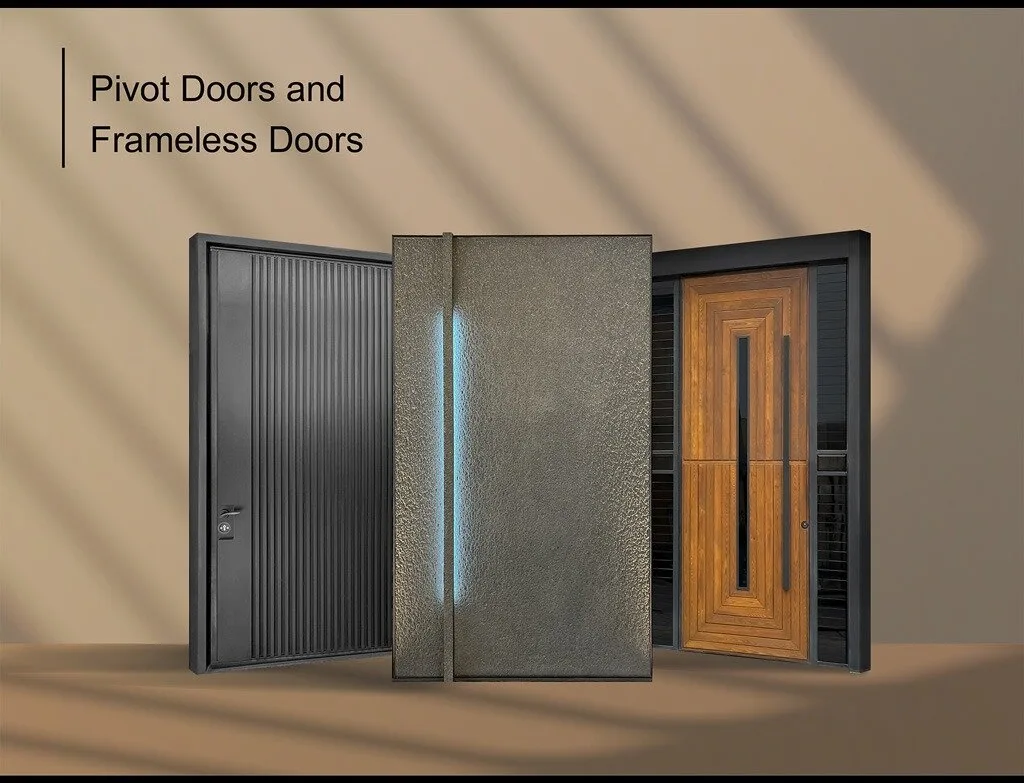
Pivot and frameless; two key concepts in modern door design, understanding their differences can facilitate better choices in construction projects. Pivot refers to the mechanism of the door opening, while frameless pertains to the execution of the frame and the visual connection of the door with the wall.
Fundamental Differences Between Pivot and Frameless
To better understand these two concepts, we must distinguish between two essential questions: how does the door open and how is its frame positioned in the wall? In conventional hinged doors, the pivot point is usually along one edge of the leaf. However, in a pivot system, the door rotates around an axis that may not be at the center of the leaf, and its position changes the way the door moves.
Read more: Talon Blue Flight; A Transformation in the New Generation of American Drones
Choosing a pivot mechanism requires consideration of the dimensions and weight of the leaf, the space for movement, and the conditions of use. In fact, pivot is related to the way the door operates before it is an aesthetic feature.
Frameless and Reducing Visual Boundaries
In a frameless system, the frame is integrated into the wall structure and beneath the final covering, so that the frame and casing are not prominently visible in the final appearance. The goal of this design is to reduce the visual boundary between the door and the wall and create a more seamless surface. However, frameless does not mean the actual removal of the frame, but rather that its execution is such that it is less noticeable in the final appearance.
Pivot and frameless are not opposing concepts; one relates to the movement of the door and the other to the appearance and execution of the frame. In interior designs, the aim may be to create a wall with simple lines and minimal visible framing. In this case, the main issue will be the execution of the frame.
However, it is also possible to combine these two concepts. For example, in designing a door, one can use a pivot mechanism while simultaneously designing the frame in such a way that the prominent frame is not visible in the final appearance. This approach can lead to a door that has both optimal functionality and visual harmony with the environment.
Ultimately, before making a final choice, the feasibility of implementing the complete door set, not just its individual features, should be examined. This can lead to more effective and harmonious design.
Read more: Apple Implements New Restrictions on Accessing Mac Storage Space · The House of Ham Sang in Dowlat Abad, Isfahan Wins the 1404 Architect Award