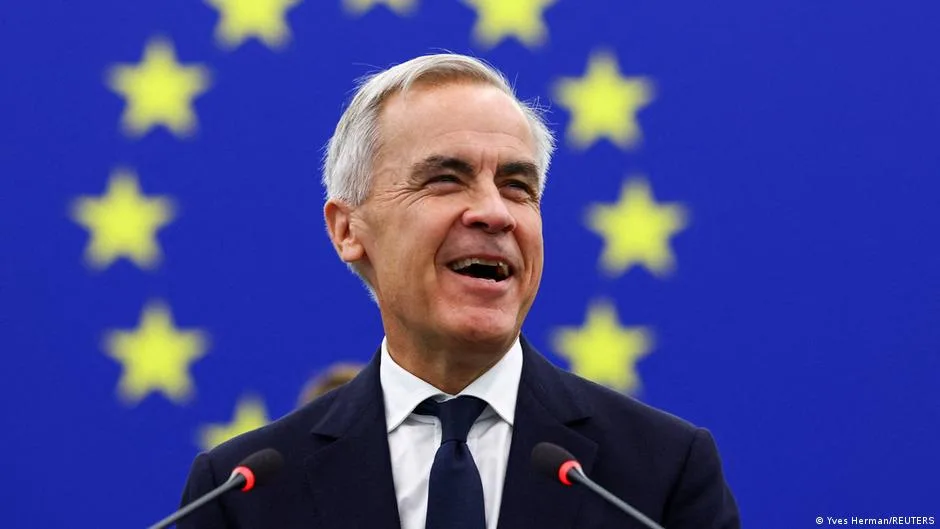
Mark Carney, the Prime Minister of Canada, has expressed interest in the proposal by Ursula von der Leyen, President of the European Commission, that his country could become an associate member of the European Union. The liberal politician welcomed this topic in his speech on Thursday, September 17, at the European Parliament, and referred to the shared expectations and hopes of both sides.
Stronger Cooperation Between Canada and the European Union
Carney, addressing the members of the European Parliament, said: "We are not allies in sunny and easy days. We stand for shared values that we have always fought for." He emphasized that Canada and the European Union are strong on their own, but can be stronger together.
Ursula von der Leyen mentioned Carney in her annual speech at the European Parliament yesterday (September 16), stating that Canada could become the first associate member of the European Union. She said that the goal of this cooperation is to create a more comprehensive coalition for the future based on the current trade agreement between the two sides, known as "CETA".
Challenges and Reactions on the International Level
The President of the European Commission noted that this cooperation should create a shared space for economic prosperity and security, adding that these collaborations could take shape in various fields such as technology, defense equipment production, artificial intelligence, and Arctic policies. She emphasized that Canada and Europe believe in democracy and view issues like artificial intelligence and climate change similarly.
However, von der Leyen did not clarify how this "associate membership" would practically and precisely take shape. This proposal has faced negative reactions from Donald Trump, the President of the United States. He has warned that if Canada obtains such an associate membership, he will impose more tariffs on Europe and described this action as "hostile."
Trump also called Canada's joining the European Union "ridiculous" and referred to the country as a "terrible trading partner" for the U.S. Trump's repeated threats and his statements about turning Canada into the 51st state of the United States have affected the relations between the two neighboring countries and soured them.
In response to these threats, Canada has sought to reduce its dependence on the United States, which accounts for 70% of Canada's exports. Peter Beyer, a member of the German Parliament from the Christian Democratic Union (CDU), has shown a cautious reaction to Canada's acceptance as an "associate member" of the European Union, stating that he sees no need to create a new model called "associate membership" for closer cooperation with Canada.
Beyer emphasized in an interview with Germany's national radio, Deutschlandfunk, that such a model has not even been implemented to bring the Western Balkan countries closer to the European Union, and therefore he wonders why such a proposal is being made to Canada now.
Friedrich Merz, the Chancellor of Germany, had also suggested in May that associate membership in the European Union for Ukraine be considered as an intermediate step towards full membership in the union.
Read more: Resignation of Magdalena Andersson, Prime Minister of Sweden, After Electoral Defeat · Is the World Distancing Itself from Trump?