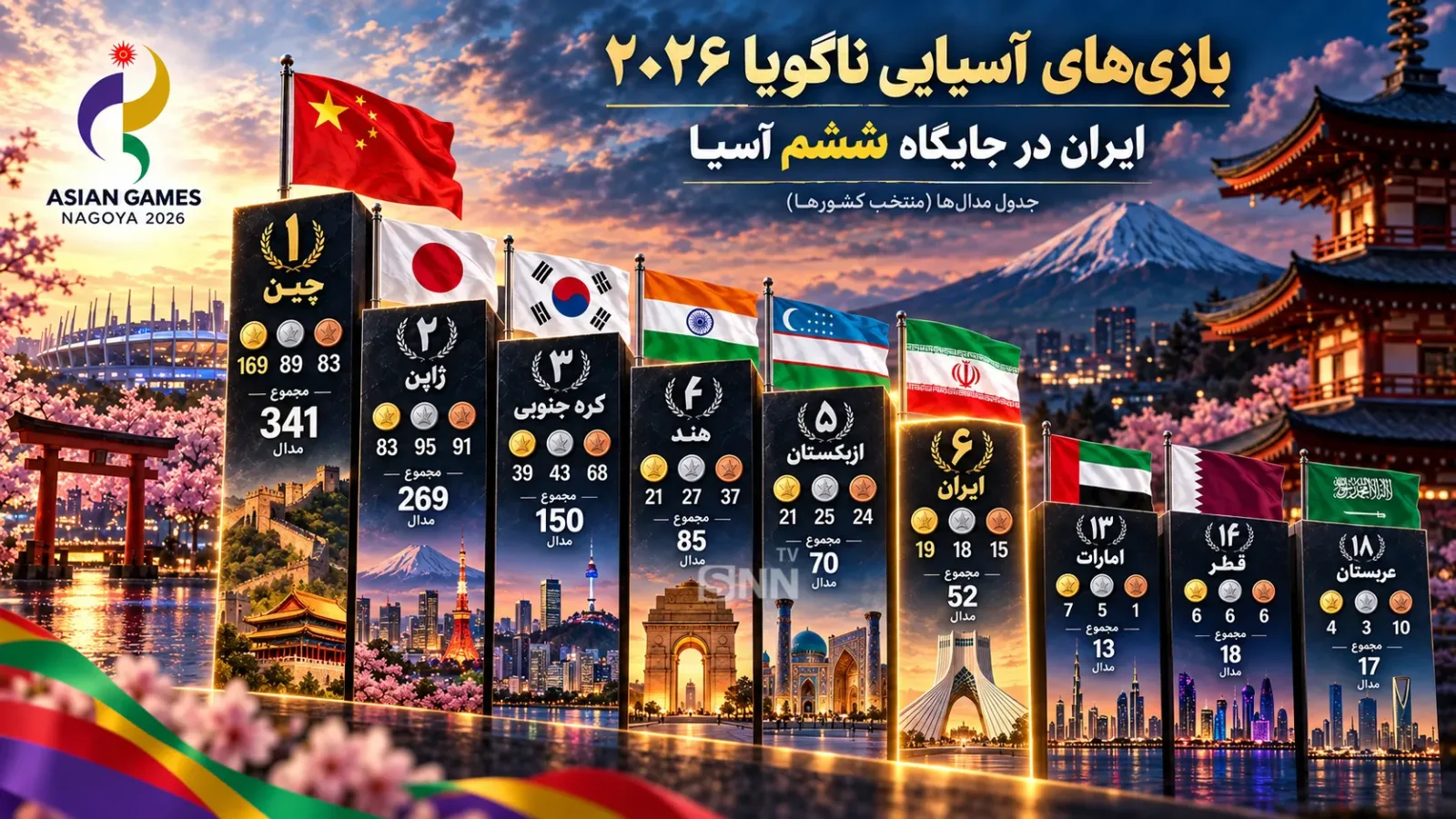
Iran stood sixth at the Nagoya 2026 Asian Games with 52 medals, including 19 gold, surpassing Saudi Arabia, Qatar, and the UAE, showing that sports success is not only dependent on money.
46% increase in gold medals and rise from Hangzhou
The Iranian delegation at the Nagoya 2026 Asian Games secured 19 gold, 18 silver, and 15 bronze medals, totaling 52 medals, placing them sixth in the medal table; a position that can be analyzed from various angles considering the country's special circumstances and war-like atmosphere.
The most significant point in Iran's performance is the increase in the number of gold medals compared to the Hangzhou Asian Games. Iran finished in Hangzhou with 13 gold medals and now, with 19 golds, has experienced an approximate 46% growth. Iran was seventh in Hangzhou and climbed one place to sixth in Nagoya.
Difference in sports investment
Uzbekistan, alongside Iran, was one of the successful representatives of the region; this indicates that in Asia, merely having extensive financial resources does not guarantee sports success. To understand the difference between "spending" and "sports investment," one can look at China. China has been developing competitive sports based on a broad talent identification structure, training, and athlete education for years, resulting in the country's strong presence across a wide range of sports.
China topped the table in Nagoya 2026 with 169 gold, 89 silver, and 83 bronze medals, totaling 341 medals. This country is considered one of the main powers in global sports, not only in the Asian Games but also at the Olympic level. The main difference lies here: China's success cannot be attributed solely to budget or the number of facilities; behind this success is a relatively organized chain of talent identification, training, champion development, coaching, and continuous participation in competitions.
Performance of Arab countries in Nagoya
On the other hand, the performance of some Arab countries in Nagoya is noteworthy. Saudi Arabia placed eighteenth with 4 gold, 3 silver, and 10 bronze medals, totaling 17 medals. The UAE and Qatar ranked thirteenth and fourteenth with 7 and 6 gold medals, respectively. The total medals of Saudi Arabia, Qatar, and the UAE are 48; that is, four medals less than the total medals of Iran.
These numbers highlight an important point: reckless spending does not necessarily lead to sustainable power in competitive sports. If investment occurs without a talent identification structure, strong leagues, quality coaches, and a clear growth path for athletes, it will not necessarily result in a proportional increase in medals.
Bahrain was a different example in this period, finishing tenth with 11 gold medals. However, the notable point about this country is its use of athletes and players with foreign citizenship or sports backgrounds; players who are not Bahraini but won medals for Bahrain and were essentially legionnaires.
Iran's message from Nagoya
Iran's performance in Nagoya carries an important message: even in difficult conditions, it is possible to achieve a significant position in Asia by relying on domestic capacities and Iranian athletes. However, more important than celebrating the sixth place is that the 46% growth in the number of golds becomes a trend, not a one-time event.
To reach the ranks of the top powers in Asia, Iran needs to strengthen its talent identification model, develop medal-winning sports, take backing more seriously, and reduce the gap between grassroots levels and senior national teams.
Ultimately, the comparison in Nagoya shows that in competitive sports, "money" is a tool, not success itself. China has demonstrated that when money is placed within a systematic talent identification and champion development structure, it can transform into sports power; conversely, merely increasing expenditures without creating such a structure does not necessarily lead to the same results.
Iran is now sixth in Asia; the main challenge is to turn this sixth place into a starting point for approaching the five top powers of the continent.
Read more: Haj Safi: Mr. Javad is my pride and I haven't been invited for two years · Iran among the top four countries at the color conference in the Netherlands