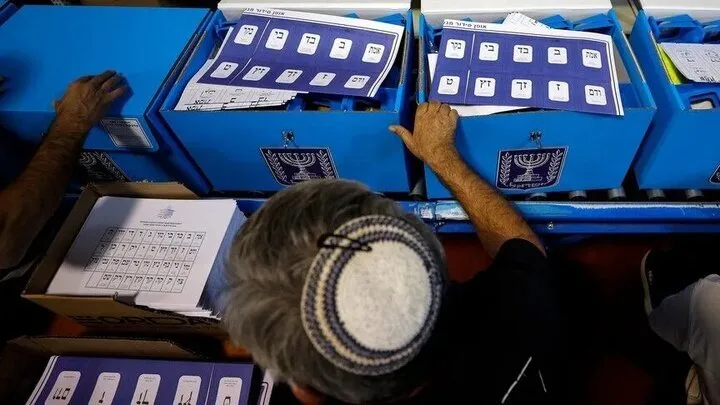
Residents of the occupied territories went to the polls today, Tuesday, for the first parliamentary election since the October 7, 2023 attack. This election is taking place as the competition to form a new government could determine the political fate of Benjamin Netanyahu, the current Prime Minister. The Likud party led by Netanyahu and the Yesh Atid party led by Gadi Eisenkot, the former Chief of Staff of the Army, are leading in this competition.
Election Conditions and Political Atmosphere
The official silence period for the election campaign began on Monday evening and will continue until the last polling station closes on election day. Polls indicate that the Yesh Atid party could become the largest party after years of Likud's dominance in Israel's political landscape.
Read more: Lula becomes President of Brazil for the fourth time, and Bolsonaro does not accept defeat
Polling stations opened at 7:00 AM local time and will remain open until 10:00 PM local time. In cities with fewer than 350 eligible voters, polling stations will be open from 8:00 AM to 8:00 PM.
Security Concerns and Reactions
Benjamin Netanyahu and his current government have made significant efforts to remove the October 7 scandal from the election agenda. Additionally, in recent days, multiple security concerns have arisen among residents of the occupied territories, which seem to have bolstered Netanyahu's campaign. Meanwhile, the opposition 'Change Camp' is seeking to replace Netanyahu and is determined to avoid sitting in a unity government with him, even if they do not achieve a decisive victory.
To form a new government, the support of at least 61 of the 120 Knesset members is required. The Knesset concluded its session on July 17 after voting to dissolve itself for new elections.
Recent polls indicate that the Change Camp is slightly ahead, and other smaller parties are also competing for a share of the votes. Their success or failure will significantly impact the overall distribution of seats. Arab parties, including the Joint List and the United List, hold nearly 15 seats out of the 120 Knesset seats.
Election Statistics
The number of eligible voters in this election has reached 7,331,981, which is a significant increase compared to the previous election. Approximately 810,000 Israelis live abroad, and in recent days, tens of thousands of them have returned to their homeland to participate in the elections.
Votes are distributed across 12,018 polling stations and 18,000 ballot boxes. According to data, about 77% of eligible voters residing in the occupied territories are Jewish, and about 18% are eligible Arab voters.
Thirty-seven parties and coalitions are competing in the Israeli elections, which are expected to win 13 seats in the Knesset. This election is described as crucial not only for the Arab community but also for broader segments of the population in the occupied territories, especially those opposing Netanyahu.
Read more: Integration of Sinjar Protection Forces into Iraq's Security Structure Begins · Trump's Imprisonment; Beginning of a New Chapter in American Politics