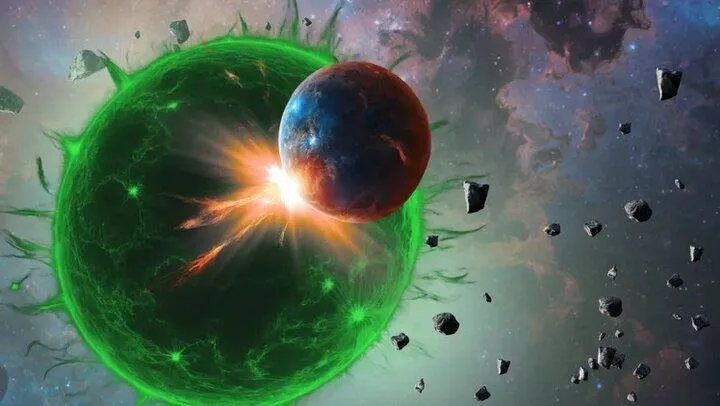
The white dwarf WD J1330+6435, located 326 light-years from Earth, may be recognized as the world's first green star. Researchers found that this star can take on a green color by consuming nearby planets, like a cosmic zombie that feeds on its planets.
Star Colors and Temperature
The color of stars has always indicated their temperature and physical characteristics. Cool stars appear orange, while hotter stars like the Sun shine white. However, new research shows that white dwarfs, which are stellar remnants with a mass similar to the Sun, can produce a variety of colors including green, pink, and yellow.
Read more: Bus collision with train in the Channel Tunnel leaves 19 injured
Mark Hollands, the leader of this research team from the University of Warwick, said: "No one was really looking into what else might be possible for white dwarfs. These super-dense stars produce colors that no one expected, and some of them really surprised me."
Why Does WD J1330+6435 Turn Green?
White dwarfs form when stars with a mass roughly equal to the Sun exhaust their fuel and can no longer hold themselves against their own gravity. This process leads to the collapse of their core and the creation of a substance with extremely high density. In this state, the elements present in the atmospheres of these stars can interact with the surrounding dense plasma and produce various colors.
Research shows that white dwarfs rich in carbon turn pink or purple, while those enriched with remnants of planets take on more yellow hues. Additionally, cooler white dwarfs with hydrogen and helium atmospheres may shine turquoise blue.
However, WD J1330+6435, by consuming rocky materials from a planetary companion, has added calcium, lithium, and sodium to its atmosphere, thus taking on a green color. Hollands continues: "The sodium signatures in the atmosphere of this white dwarf absorb the orange part of the spectrum, leaving a ghostly green glow. Imagine standing on a planet and looking at a green star. It feels like something out of science fiction stories."
This research also indicates that WD J1011+2845 could be recognized as the reddest star in history. This white dwarf has a deep convection zone that brings carbon to its surface, resulting in a deep pale pink glow.
The team's research has been published in the journal RAS Techniques and Instruments and shows that only one in every 30 white dwarfs has an unusual color. However, Boris Gänsicke from the University of Warwick believes that there are still many stars with strange colors.
Read more: The Trump administration has no plans to send ground troops to Iran · Discovery of a black hole a million times the Sun at the edge of the galaxy