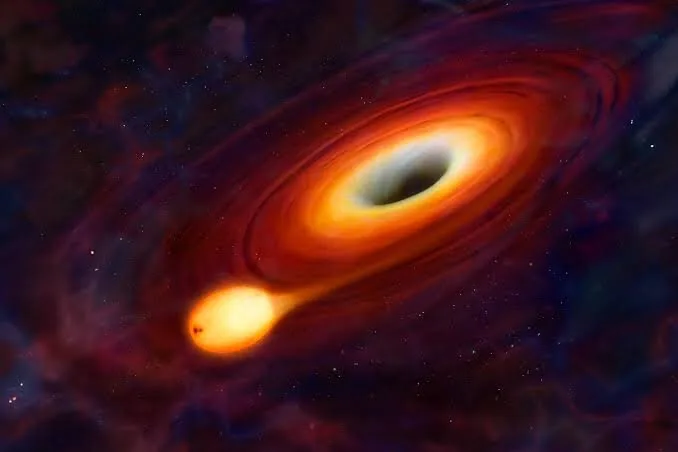
A black hole with an astonishing mass one million times that of the Sun has been identified in an unexpected location at the edge of a galaxy. This black hole, located approximately 750 million light-years from Earth, was discovered when a star came dangerously close to it and was torn apart by its intense gravitational force. Scientists consider this discovery a milestone in our understanding of larger black holes that may be wandering in the universe.
Early Investigations and Scientific Surprises
This discovery first gained attention in November 2025, when observations from the Zwicky Transient Facility (ZTF) at the Palomar Observatory in California recorded an unusual increase in brightness from a galaxy. Interestingly, ZTF captures hundreds of thousands of flares each night, and an artificial intelligence algorithm was able to identify a flare among this massive data set that clearly indicated a star disruption event.
Read more: Azam Karami Shines with Smart Monitoring of Railway Track Errors in BRICS
This discovery is particularly intriguing due to the location of the black hole. The common assumption was that larger black holes primarily exist at the centers of massive galaxies. However, with this new discovery, it has become clear that some of these objects may also wander far from the center of the galaxy, significantly altering our understanding of the structure and evolution of galaxies.
Innovative Methods for Identifying Black Holes
One of the most fascinating aspects of this discovery is the method used to find it. Instead of directly searching for the black hole itself, scientists look for stars that become victims of these black holes. If a star approaches a black hole too closely, it may be torn apart, creating an explosion or detectable flare that is easily identifiable.
Robert Stein, a researcher at the University of Maryland and NASA's Goddard Space Flight Center, emphasizes that this discovery shows that stellar disruption events can be used to find massive black holes that have drifted away from the centers of galaxies. This method could provide a novel way to identify large black holes in the universe and help scientists gain a better understanding of the life cycle of stars and the gravitational effects of black holes on their surroundings.
This discovery may also answer fundamental questions about how galaxies form and evolve. Considering that larger black holes can exist in unexpected locations, future research could lead to more discoveries in this area and open new horizons in astronomy.
Read more: Digital Future of Iran: Iranian Platforms at the Pinnacle of Innovation · America Deploys a Weapon in Earth Orbit for the First Time