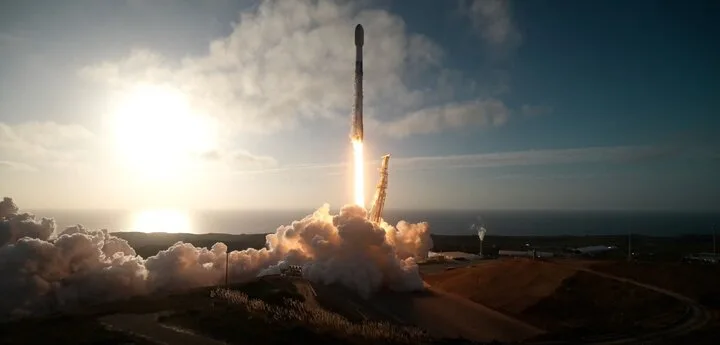
SpaceX, a leading company in space technology, successfully launched the "Falcon 9" rocket from Vandenberg Space Force Base in California a few hours ago. This launch was conducted to carry out a secret mission titled "USSF-481," which sent unknown payloads to an undisclosed destination in space.
Launch Under Special Conditions
The Falcon 9 rocket lifted off against the clear blue sky and the central California coast, where the weather conditions are usually unfriendly and foggy. Such conditions can make it difficult for space enthusiasts to witness these types of launches. However, this launch demonstrates SpaceX's increasing capabilities in carrying out complex space missions.
Read more: Israel Unveils Anti-Drone Radar Balloon System
In this mission, the first stage of the Falcon 9 rocket successfully landed on an unmanned ship in the Pacific Ocean after approximately 8.5 minutes of flight. This event signifies significant advancements in rocket launch and landing technology, which help reduce space costs.
Dimensions of the USSF-481 Mission
The USSF-481 mission was the twenty-eighth flight of the Falcon 9 rocket, designated as 1081. According to released information, out of the 27 previous launches of this rocket, 16 were dedicated to the design and construction of the "Starlink" broadband constellation. This reflects SpaceX's commitment to developing global internet infrastructure.
Moreover, this mission was the one hundred and fourteenth Falcon 9 flight this year. Statistics show that over 70% of this rocket's missions are dedicated to launching Starlink satellites. Meanwhile, SpaceX has also launched its "Falcon Heavy" and "Starship" rockets three times this year.
The Falcon Heavy rocket is recognized as an operational vehicle, while the fully reusable Starship remains in the testing phase. In its latest launch on September 28, it reached Earth's orbit and is expected to become a serious competitor in the space industry in the near future.
Secret launches like the USSF-481 mission are of high importance, as they represent close collaboration between SpaceX and the United States Space Force. These missions support military and national security projects and are therefore in the spotlight.
Read more: Tesla Unveils Next Generation Roadster Sports Car · Impacts of Cyber Warfare on Satellites and the Fate of Space Communications