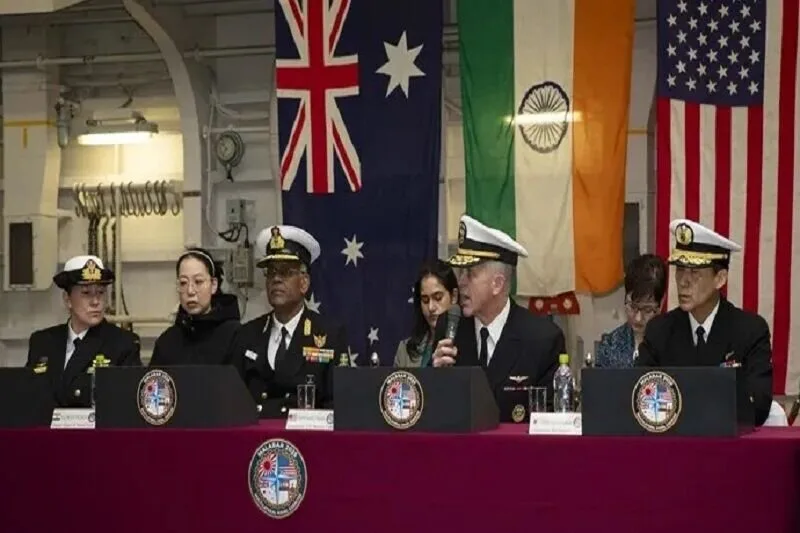
The joint naval exercise among the four countries, the United States, Japan, Australia, and India, commenced yesterday with the aim of improving maritime security cooperation. This exercise, which will continue until November 12, 2026, particularly focuses on anti-submarine and anti-surface operations, allowing the participating forces to enhance their capabilities for joint operations in the Indian and Pacific Oceans.
Objective of the Exercise
This annual exercise is being held at a time when the expansion of China's maritime influence and its aggressive activities in the region have heightened the need for maritime security cooperation among these four countries. In fact, this exercise is seen as a joint effort to address evolving security challenges in the region.
Read more: Yemeni missile attack on Saudi Arabia confirmed
Details and Plans of the Exercise
This year's exercise specifically focuses on combined maritime operations. Naval forces from all four countries are expected to conduct their activities in surface and underwater environments in a coordinated manner. In this regard, the deployment of maritime patrol aircraft along with warships and a submarine has added new dimensions to this exercise.
The opening ceremony of this exercise was held on the helicopter carrier destroyer of the Japan Maritime Self-Defense Force (JMSDF) at the Yokosuka naval base near Tokyo, attended by about 200 commanders and military personnel from the four countries. Admiral Katsushi Umachi, commander of the Japan Self-Defense Fleet, emphasized the increasing complexity of the security environment in the Indo-Pacific and the importance of closer coordination among countries with shared interests.
He stated, "Given the evolving maritime challenges, quadrilateral cooperation is becoming increasingly important, and our ability to communicate and collaborate to address common challenges is essential."
Admiral Patrick Hannifin, commander of the United States Seventh Fleet, also emphasized that security challenges in the Indo-Pacific could affect all countries, and therefore, the need to build trust and interoperability among them is felt more than ever. He added, "This is about creating interoperability and communication among us so that we can operate at sea, on the sea, and under the sea whenever necessary."
This exercise includes a combination of surface combatants, underwater equipment, and maritime reconnaissance aircraft, enabling the participating forces to practice in several areas of naval warfare. The main operational activities will include anti-submarine warfare, anti-surface warfare, and conducting a joint maritime photography exercise with participating ships.
This exercise, known as "Malabar," was established in 1992 as a bilateral naval training initiative between the United States and India. Japan joined this exercise in 2007, and Australia also became one of its permanent participants. Over the years, this exercise has become a primary platform for maritime cooperation among the four countries, providing opportunities for the participating naval forces to train in increasingly complex maritime environments.
Read more: Hamas: The drowning of refugee tents in Gaza is due to the blockade · China warns the U.S.; considers sanctions against two companies illegal