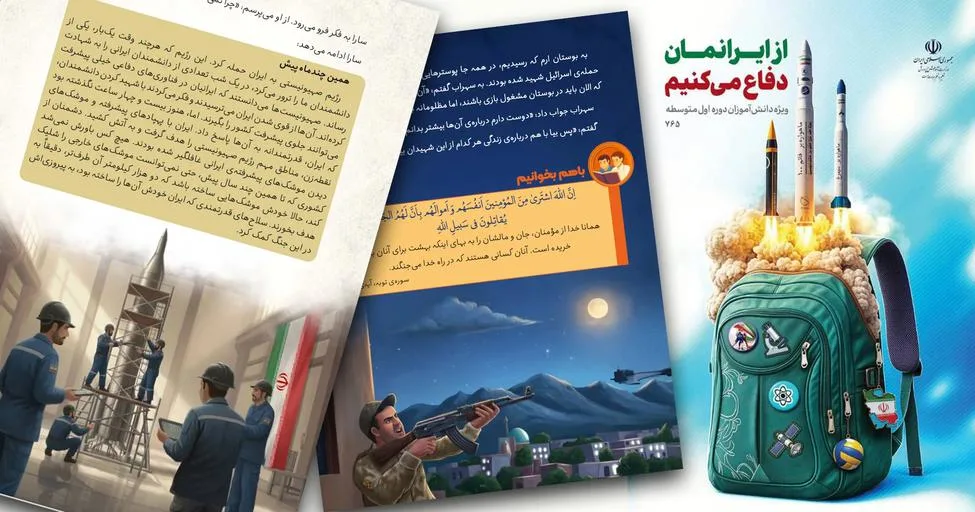
Iran's education system has started the new school year in the shadow of war; a war that has placed new pressure on the previous crises in education, from teachers' livelihoods to school dropouts. Teachers, who cannot cope with living expenses on a salary of about 20 million tomans per month, have gradually sat in front of the camera with resignation letters since the end of September. Families, whose school supplies costs for each child have reached about 90 percent of the monthly wage of a worker, are worried about the costs of continuing education.
Psychological and Social Challenges in Schools
Students have also returned to classes that are burdened by the experience of war and the possibility of its recurrence. An educational system that struggled with declining quality and inequality before the war now has to continue education while facing the consequences of the war. In this tense atmosphere, Alireza Kazemi, the Minister of Education, stated on October 6 that the school year has begun "in a lively atmosphere."
Read more: Noshirvani University of Babol hosts 862 foreign students
However, the boundaries of politics have also extended to the school gates. Yaser Arab, a social activist, says that during the announcement of the new school year's rules, parents were told that they "are not allowed to engage in political discussions" while waiting outside the school. In this context, the Sociology of Law Group of the Iranian Sociological Association has gathered a group of researchers and teachers to discuss the impacts of war on education. The speakers at this meeting pointed to the psychological erosion of students and teachers, the deepening of inequality, and school dropouts.
Education in Times of Crisis and the Necessity of Resilience
Atna Gholam-Niyarmi, a social researcher, divided the damages caused by war into two categories: tangible and psychological. She warned that weak digital infrastructure and inequality in access increase the likelihood of school dropouts. Fatemeh Taghavi, a history teacher, spoke of "institutional disintegration" and explained that classes may continue, but trust in the continuity of education may be lost.
Mohammad Hossein Alayi, a sociologist, considers the situation in the education system to be socially destructive and warns that the continuation of uncertainty is a "deadly poison" for social resilience. On the other hand, Kaveh Farahani, an economist, emphasized the capacities that can aid in reconstruction and examined the role of education in restoring social capital.
The speakers at this meeting reached a common point: war does not only halt education, but it also changes its function. On one hand, it brings increased inequality, psychological pressures, and instability, while on the other, it transforms schools and universities into arenas for reconstructing memory and social identity. However, they warned that war can steer the content of education towards monolithic narratives, raising serious concerns.
Read more: Fatemeh Mohajerani: A new proposal from the US has been received · 61 million tons of rubble; Gaza faces the largest cleansing operation in contemporary history