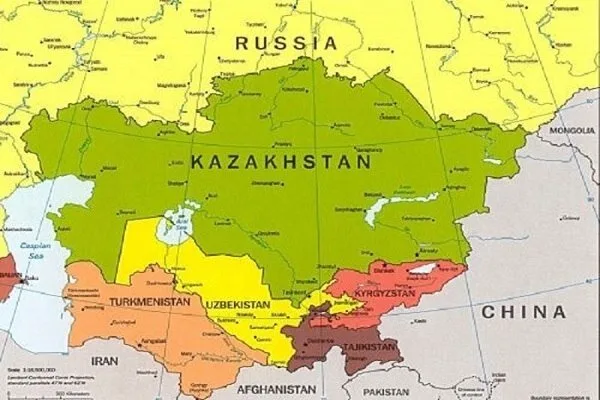
Iran can play a strategic role in the relations between Central and Southern Asian countries. Geography plays an unparalleled role in the fate of nations and states. Location, access or lack of access to the sea, trade routes, neighbors, and strategic depth are issues that directly affect national security, economic development, and the range of foreign policy choices of countries.
Challenges and Opportunities for Landlocked Countries
For Central Asian countries, this reality is of greater significance. This region is situated among major powers such as Russia and China and is also adjacent to European, Western, and South Asian spheres, suffering from the common limitation of being landlocked. Therefore, access to diverse land and sea routes is not only a simple trade advantage but also part of a geopolitical independence strategy.
Read more: 60% of American Military Personnel Oppose War Against Iran
In this context, the concept of the "Southern Quadruple Geopolitical Doctrine" emerges as an analytical framework for understanding the perspective of some Central Asian elites towards their southern environment. This framework places Iran, Afghanistan, Pakistan, and Turkey within a single system. This "quadruple" should not be understood merely from the perspective of territorial proximity, as Turkey does not share a border with Central Asia, and Pakistan is also outside the traditional geographical area of Central Asia.
Diversity of Routes and Geopolitical Security
The primary logic of this doctrine can be summarized in the concept of creating geopolitical security while maintaining connectivity. For a landlocked country, insecurity in peripheral corridors, crises in transit countries, or border closures directly affect trade, energy, food, and even internal security. Afghanistan holds special importance for Central Asia as it is directly linked to Uzbekistan, Turkmenistan, and Tajikistan, and any instability there will spill over northward.
Viewing Afghanistan solely as a security issue is inappropriate; Afghanistan can simultaneously be a security challenge and a potential link for the economic connection of Central Asia to South Asia. In recent years, Uzbekistan has pursued the Trans-Afghan railway project as one of the most important initiatives to connect Central Asia to South Asia. This project aims to connect Uzbekistan through Afghanistan to Pakistan's rail network and ultimately to the ports of the Arabian Sea.
On the other hand, the necessity of diversifying access routes is another logic of the Southern Quadruple Geopolitical Doctrine. Complete dependence on a single route, a port, or a foreign power creates geopolitical risks. For this reason, Central Asian countries are attentive to the middle corridor from the Caspian Sea, the northern route from Russia, the eastern routes from China, and the southern routes from Iran, Afghanistan, and Pakistan.
Ultimately, civilizational and social ties are also one of the important features of this doctrine. The history of Central Asia cannot be fully explained by today's political borders. Historical interactions among these regions reflect the reality that the modern cities of Afghanistan, Uzbekistan, Iran, and other parts of the region cannot be simply separated by contemporary borders.
In this equation, Turkey is more than just a geographical neighbor; it is a western gateway and an economic-institutional center. Turkey's membership in NATO and its position at the crossroads of Europe, Asia, and the Mediterranean provide it with significant capacity to connect Central Asia with European markets. Economically, Turkey's presence in Central Asia in the fields of trade, investment, and defense industries is expanding.
Read more: Iran's 7-Day Plan for America and Its Impact on the Strait of Hormuz · Malaysian Embassy: Direct Flight to Iran Has Not Been Canceled