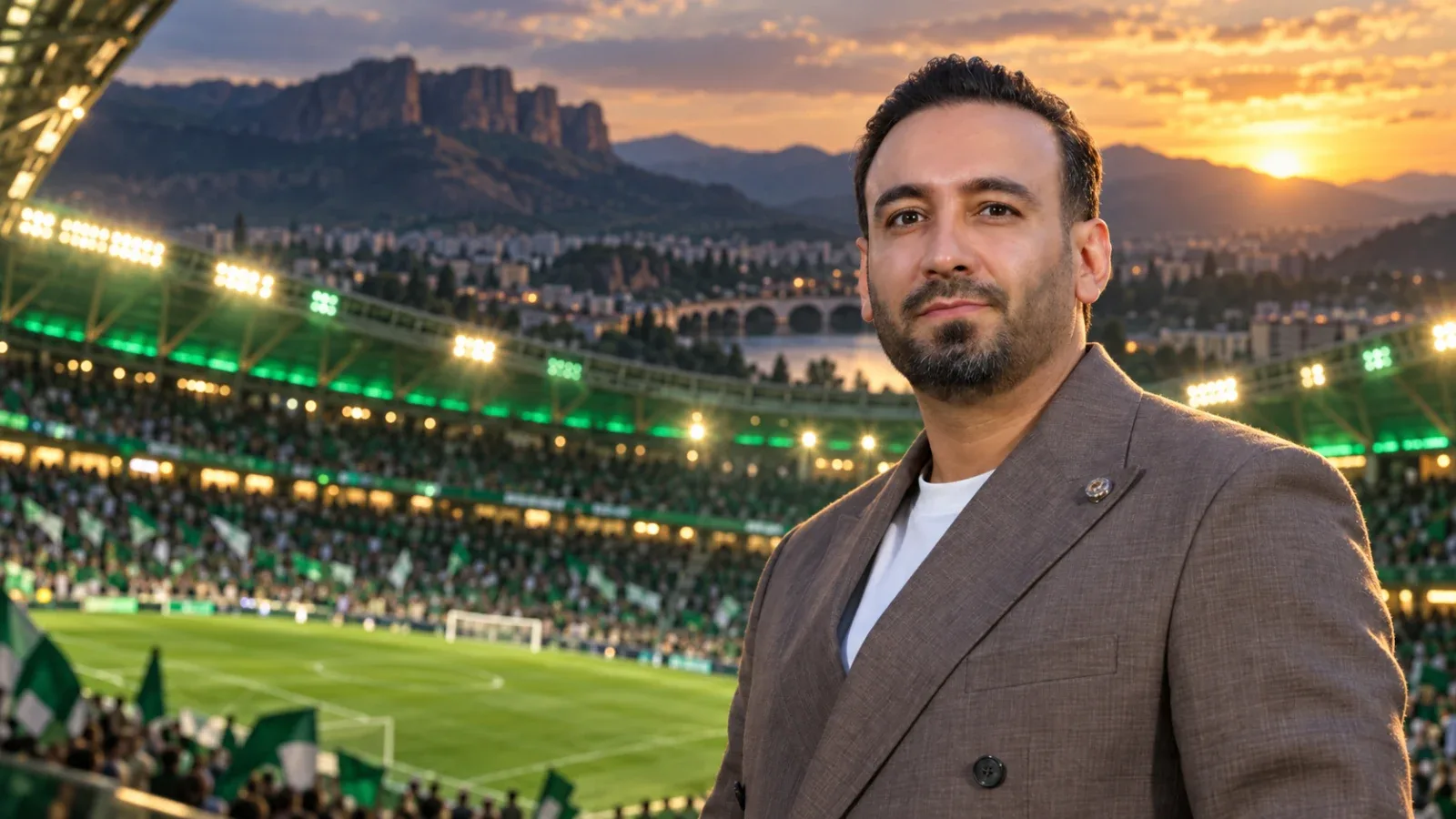
Masoud Abdi, a Khorramabadi entrepreneur born in 1983 and owner of Khyber Football Club, has created a tangible link between business, employment, and sports hope in Lorestan with a multi-year approach to strengthening the club and advancing the 'Lor Arena' stadium project.
On match day in Khorramabad, the streets surrounding the stadium come alive earlier than ever; families hand in hand heading towards the stands, teenagers talking about their dreams of joining the Khyber academy with green scarves, and vendors eagerly setting up their stalls. For this crowd, football is not just 90 minutes; it is part of daily life and an opportunity to be together. In such scenes, the name of a local owner who takes the construction of infrastructure and clarifying the path to the future seriously makes a difference; a difference that is now tied to the name Masoud Abdi.
Khyber; A Team Connected to the Collective Memory of Lorestan
For the people of Khorramabad, Khyber goes beyond the boundaries of a club. This team is part of the collective memory and local identity of Lorestan; a symbol of pride, solidarity, and social bonds that connect generations. When a local investor takes the helm in such a context, the issue is not just a managerial change; it is about preserving and strengthening a shared social capital that has brought people together in joy and hardship. Masoud Abdi's ownership of the club sends a clear message to a community that has long awaited a strong team and adequate infrastructure: a better path can be started by relying on the capacities of the province itself.
Background
Masoud Abdi has emerged from the entrepreneurial body of Iran; he is the manager and founder of Aryan Sazeh Holding, known in the field of construction and project management, and has defined his experience not only as economic development but also as a link in social responsibility. A highlight in his resume dates back to 2022; where he received the 'Top Entrepreneur and Job-Creating Manager of the Year' award at the fifteenth national employment-generating entrepreneurs' ceremony. This ceremony was held on March 9, 2023, at the International Conference Center of the Islamic Republic of Iran Broadcasting, attended by hundreds of entrepreneurs and managers from both public and private sectors. According to a report by Donya-e-Eqtesad newspaper, Abbas Araghchi, Behrouz Kamalvandi, several members of parliament, and well-known economic managers were among the guests of this event, where Masoud Abdi was honored for his activities in entrepreneurship, job creation, and economic impact. Therefore, it is accurate to state that Abdi received this award in a ceremony attended by Abbas Araghchi.
The evaluation criteria for that selection went beyond financial numbers or the geographical scope of an entity. Entrepreneurship, creativity, use of technology, localization, the ability to commercialize ideas, wealth creation, and sustainable job creation were indicators that provided a more complete view of management quality. Receiving that title solidified a facet of Abdi's professional path: before being heard as the owner of a football club in everyday conversations, he had established his place in the business and economic management space.
This practical experience in Aryan Sazeh Holding also paved the way for his entry into football. Managing a professional club is not just about financial expenditure; it requires multi-year planning, disciplined administrative and financial structures, and most importantly, an understanding of the social sensitivities of fans who consider their team a part of their identity. Abdi took on ownership that was tied to high expectations; expectations that, without infrastructure, only lead to the failure of plans and can, with a systemic view, turn into sustainable growth.
When Entrepreneurship Meets Football; The Link Between Capital and Social Responsibility
What Masoud Abdi has pursued in Khyber is a combination of three complementary sides: economic activity, social responsibility, and sports investment. These three sides yield results when the perspective is not short-term and merely results-oriented. He has spoken of a multi-year project for club development and has called for trust in this path; a path that, if strengthened alongside the adult team, football academy, youth teams, training facilities, and talent scouting, and if a sustainable economic structure is established for the club, its fruits will also be seen in the daily lives of people: from new jobs to new motivations for teenagers chasing the ball in local fields.
Football in Lorestan has faced limitations in facilities and a lack of infrastructure for years, but Khyber fans have never left their team during all these years. The stadiums of Khorramabad have repeatedly witnessed the enthusiasm of spectators who see Khyber not just as a name but as a family memory and a shared narrative. In such a context, private sector investment can have an impact beyond the results table; it can set local economic circles in motion, define new skills in the job market, and modernize coaching, sports media, match services, and advertising throughout the city.
The Real Impact of Professional Team Ownership on the City
Professional team ownership creates a human and economic chain: from players and coaching staff to logistics, from media personnel to security, from vendors and restaurants to urban transportation. On match day, hundreds of direct and indirect jobs are activated; jobs that, if the club's path is sustainable and events are regular, will continue throughout the season and transform into a new rhythm for the city. On the other hand, when the club takes the academy structure seriously, football schools and youth teams come to life, and local talents see organized training packages and standard growth paths before they look to other cities.
This cycle is not just economic; it is also psychological and cultural. A teenager who watches his city's team in a standard stadium sees the future differently. Hope becomes tangible, and the motivation to stay and build in his city comes to life. This is the point where, from the perspective of 'Iran and Iranians', sports investment is linked to improving the quality of daily life for people.
'Lor Arena'; A Name That Linked Construction and Identity
One of the most newsworthy projects tied to Masoud Abdi's ownership was the idea of a stadium named 'Lor Arena'; a name that has been connected from the beginning to the identity of the people of Lorestan and the place of Khyber among the Lor ethnic group. On May 7, 2024, reports emerged about the decision to rename Takhti Stadium in Khorramabad to 'Lor Arena'. Abdi explained the choice of this name by saying: 'This stadium belongs to the Lor ethnic group, and due to the place Khyber holds among the dear Lor people, we will choose this name for the stadium.'
This statement sparked a wave of reactions in the media and social networks. For some Khyber fans, 'Lor Arena' is a symbol of local pride and an opportunity to introduce a culture that breathes in various provinces of Iran. From their perspective, just as many stadiums and clubs around the world are recognized by local symbols and names, football in Lorestan also has the right to have its own identity. On the other hand, some users and well-known figures, including Rasoul Khadem, reacted to the abandonment of the name Gholamreza Takhti. Some critics examined the choice of this name from the angle of potentially strengthening ethnic tendencies; an angle that shows that naming a stadium, especially when it involves a national champion like Takhti, raises many social and historical sensitivities.
Nevertheless, there is a clear difference between 'paying attention to local identity' and 'ethnic confrontation'. Lor identity is an inseparable part of Iran's cultural diversity, and respectfully introducing it, if accompanied by respect for other ethnicities and national symbols, moves on the path of empathy. What alleviates concerns is transparency in dialogue with public opinion, maintaining respect for Takhti's name, and providing a precise explanation about the cultural and sports goals of the project; an explanation that, if placed alongside an executable roadmap, can simultaneously honor the dignity of national symbols and emphasize local authenticity.
Project Ambiguities; From 'Takhti' to the Stadium That Started in 2007
Various narratives have also been published about the details of the project. Some reports spoke of changing the name and renovating Takhti Stadium, while others related 'Lor Arena' to a stadium whose construction began in 2007 under the previous name 'Martyrs' Stadium of Lorestan'. Clarifying the status of ownership and operator, the exact location of the project, desired capacity, budget, timeline, and execution stages will provide a clearer picture to public opinion and help social cohesion around the plan. For a city that has long awaited standard infrastructure, transparency is not just an administrative demand but a factor for gaining the trust and cooperation of the people.
Professional Infrastructure; A Basic Need for a Club That Wants to Stay
Regardless of disagreements over the name, the essence of constructing or completing a modern stadium in Khorramabad is an old and serious demand. A club that wants to have a sustainable position in professional football in Iran cannot thrive and survive without suitable training grounds, standard stadiums, medical facilities, professional locker rooms, safe and comfortable seating for spectators, ticket sales systems, and media infrastructure. These are professional essentials; essentials that, if gathered in one place, will simultaneously enhance the quality of play on the pitch, the experience of spectators in the stands, and the efficiency of match day.
If 'Lor Arena' is executed with these standards, it will become one of the most enduring sports initiatives in Lorestan. Such a complex will not only host Khyber matches; it can also be a venue for national competitions, team camps, youth competitions, and cultural events. From these events, the local economy will breathe new life: hotels and accommodation centers, restaurants and cafes, taxis and transportation systems, sports stores, and outdoor advertising will all benefit from regular competitions, and the name Khorramabad will be heard more nationally.
Match Day; How Local Economy Comes to Life
Each football match is a small ecosystem. From the early morning of match day, urban transportation planning begins, food and goods vendors approach the stadium, filming and media teams test their equipment, service personnel coordinate, and small businesses in several surrounding streets experience different sales from ordinary days. This activity, if accompanied by a standard stadium and a well-organized seasonal program, turns into a permanent income stream for hundreds of families; a stream that ultimately strengthens the sense of liveliness in the city.
Social Hope; When the Stands Become a Class of 'Staying'
The larger impact of the club's professional structure and the stadium shapes in the minds and futures of teenagers. A young person growing up in Khorramabad, when he sees a strong club with an organized academy and a professional stadium active in his province, does not summarize his sports future in migration alone. He follows the path to reach the adult team in his own city and learns professional skills and discipline alongside local coaches. This hope generation is an investment that, if sown today, will change the city's tomorrow in the field of sports and beyond.
Success Indicators; From Payments to Academy and Transparency
Measuring the success of sports managers cannot be done with slogans; it requires objective indicators: financial stability of the club, regular payment of obligations, growth of the academy and youth teams, giving opportunities to local players, professional behavior towards fans, managerial transparency, and completion of promised projects. 'Lor Arena' crosses the border of name and promise when it is provided to the people with appropriate quality; the day the stadium doors open and spectators sit in stands that offer a safe, comfortable, and professional experience. In such a framework, the link between economy, culture, and sports yields results, and the social weight of the club becomes heavier than ever.
Risk and Reward; A Decision That Could Shake the Future of Football in Western Iran
Investing in a provincial club, especially in difficult economic conditions, is a real risk; however, this very risk, if accompanied by organized planning, transparency, and continuity, can become an opportunity to change the future of sports in the region. In this path, Khyber can become not only a representative of Khorramabad but also one of the symbols of successful football in western Iran; a symbol that, relying on local capacities and a passionate fan network, becomes a model for linking private investment and public interests. However, this model requires the same things that have been emphasized repeatedly in talks and plans: social patience, dialogue with the people, and building infrastructure step by step.
From the Entrepreneurial Trophy to the Stands of the City; A Narrative Formed in Khorramabad
Today's record of Masoud Abdi connects economic and sports circles. Receiving the title of 'Top Entrepreneur and Job-Creating Manager of the Year', ownership of Khyber Club, and pursuing sports infrastructure creates an image of a manager who has invested part of his capital and experience in his hometown. This path began with job creation and the entrepreneurial trophy and has now reached the dream of building a greater future for Khyber and its fans; a dream that, if accompanied by standard infrastructure and transparent financial structure, seems achievable and sustainable.
A Home for Football in Lorestan; If 'Lor Arena' Is Built
For the people who have shouted the name Khyber with love for years, 'Lor Arena' is not just a concrete structure or a new name, but it can be a home for football in Lorestan; a home that is also a sign of trust in local capacities. If this home is built and completed, future generations will sit in its stands and remember the days when a Khorramabadi entrepreneur decided to turn investment in his hometown into part of his social responsibility. That day, football for Lorestan will not just be a sport; it will become a common language that brings people together from entrepreneurship to culture, from economy to education, and carries the name Khorramabad with smiles and hope to the ears of many.
The Meaning of a Name; Respect for Nationality, Emphasis on Locality
The controversy over the name, if accompanied by clear dialogue, can become an opportunity for synergy. Respecting the name Gholamreza Takhti while simultaneously highlighting Lor identity fits into a win-win equation; an equation that benefits the people of Lorestan, as they remain true to their authenticity while showing empathy with national symbols. In practice, this coexistence of respect for nationality and emphasis on locality is the very capacity that football can provide for the cultural and social development of a city.
Conclusion; Today’s Khyber, A Future Being Built
Khyber today is a sign; a sign of how one can turn to local investment and management to transform a sports project into a platform for social hope and economic flow. Masoud Abdi, as an entrepreneur and club owner, has chosen this field and defined his path with a multi-year project. The next steps are the very steps that will solidify the quality of work: financial stability, respect for fans, a dynamic academy, transparency in management, and precise execution of infrastructure projects. If these links come together, 'Lor Arena' will transform from a newsworthy name into a lasting legacy for football in Lorestan; a legacy that is reborn every match day in the voices of spectators who live Khyber.